Validation Framework

Validation rigor under live execution conditions

IBEX systems are validated under live execution environments rather than theoretical backtest assumptions. The framework evaluates not only whether distortions are identified, but whether participation remains executable, observable, and disciplined under real market conditions.

Validation is grounded in execution reality — not simulated performance.

VALIDATION PHILOSOPHY

Validation Under Real Execution Conditions

Systematic trading systems often appear robust in modeled environments but deteriorate when exposed to actual execution conditions. IBEX validation is structured to test whether trading behavior remains executable, observable, and controlled under real market constraints.

Institutional FX Validation Architecture Framework

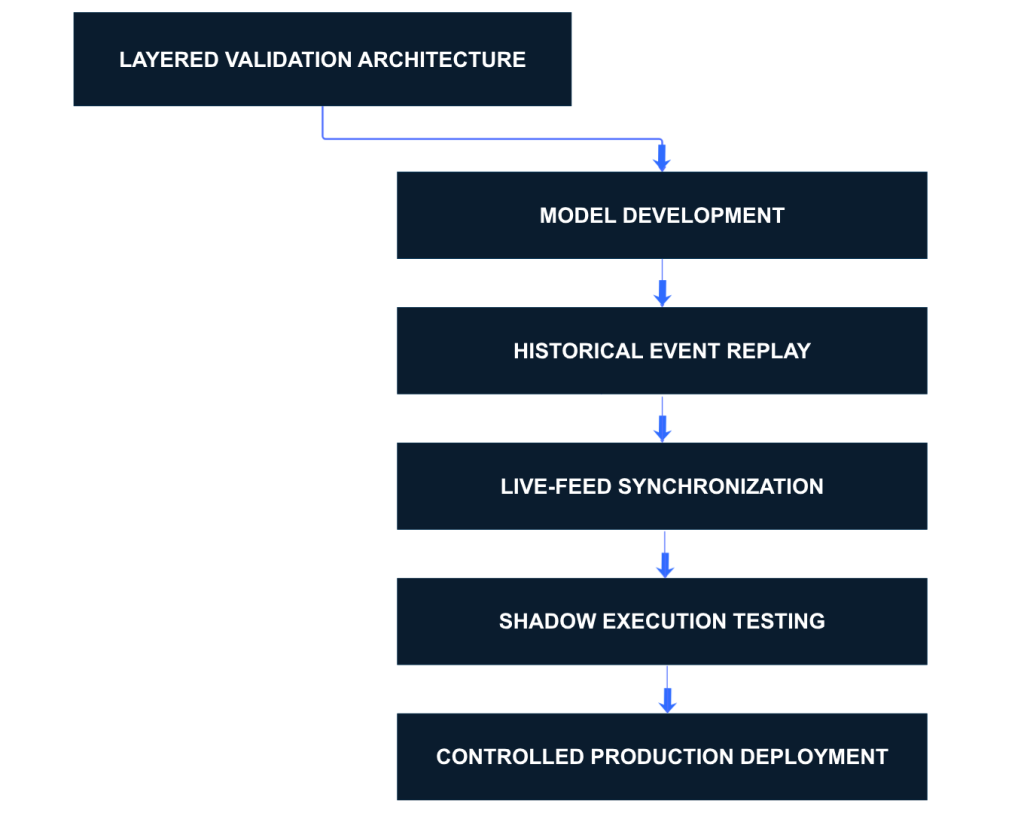
Layered validation architecture from model development through controlled production deployment.

Validation Process


Layered validation architecture

Validation is conducted through a structured, multi-stage process that progressively exposes system behavior to increasingly realistic market conditions. Initial model development is followed by historical event replay, where the system is evaluated against past dislocation environments. Subsequent stages introduce live-feed synchronization and shadow execution testing, allowing trading decisions to be assessed under real-time conditions without capital deployment. Only after execution viability is consistently demonstrated does the system transition to controlled production deployment.

Each stage increases environmental realism before capital is permitted to interact with live markets.

Framework

Observable Validation
Across the Execution Lifecycle

IBEX validation continues beyond process design. Once operating under live market conditions, the system is evaluated through structured execution monitoring, order-event capture, and institutional audit controls.


01


Live-Feed Execution Validation

Validation occurs under live market conditions with direct exposure to spreads, depth, liquidity variation, and realized fill outcomes.

02


FIX Protocol Order Logging

Execution events are captured through structured FIX protocol messaging, enabling full traceability across routing, execution, and fill lifecycle.

03


Execution Quality Monitoring

Slippage, latency exposure, fill probability, and adverse selection are continuously evaluated to ensure execution remains within defined tolerances.

04


Continuous System Auditing

System behavior is continuously audited through execution logs, state monitoring, and validation controls designed for institutional oversight.

Validation is grounded in observable execution conditions, not inferred from simulated outcomes.